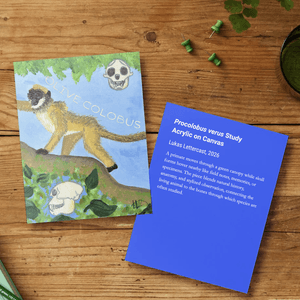
Hang out with me while I share my special interests! Today is a powerpoint covering the genus Paranthropus: Robust Australopiths, “Nutcracker Man,” and Early Pleistocene Diversity This episode surveys Paranthropus (“Nutcracker Man”), focusing on the three widely recognized species—P. robustus, P. boisei, and P. aethiopicus—and what their chronology, anatomy, diet, and phylogeny suggest about Plio-Pleistocene hominin diversity in Southern and Eastern Africa. It explains the genus’ diagnostic robust chewing complex (enlarged molars and premolars, reduced front teeth, thick mandibles, broad zygomatics, and frequent cranial crests) while emphasizing that these traits can reflect function, development, and inheritance. P. robustus (South Africa; ~2.3 to ~1.0–0.8 Ma) is described with cave-site taphonomic cautions, mosaic postcrania consistent with habitual bipedality and retained climbing, and cautious discussion of tool associations. P. boisei (East Africa; ~2.5/2.3 to ~1.34 Ma), including OH5, is highlighted for extreme megadontia and a strong C4 isotopic diet signal. P. aethiopicus (East Africa; ~2.8–2.1 Ma), exemplified by the Black Skull (KNM-WT 17000), combines early robust traits with a more primitive, prognathic face and a fragmentary record. The episode concludes that Paranthropus overlapped with early Homo, resists linear evolutionary models, and likely disappeared before the Middle Pleistocene for multi-causal reasons still debated. 00:00 Meet Paranthropus 00:32 Robust Traits Explained 01:21 Range and Fossil Context 02:05 Evolutionary Puzzle 03:21 Key Anatomy Overview 05:06 Paranthropus robustus 08:55 Robustus Diet and Tools 10:23 Paranthropus boisei 11:18 Boisei Diet Evidence 15:06 Paranthropus aethiopicus 16:57 Black Skull Takeaways 19:18 Species Comparison 21:19 Extinction and Big Picture 23:35 Wrap Up and Thanks